Table of Contents
4 min read
April 26, 2026

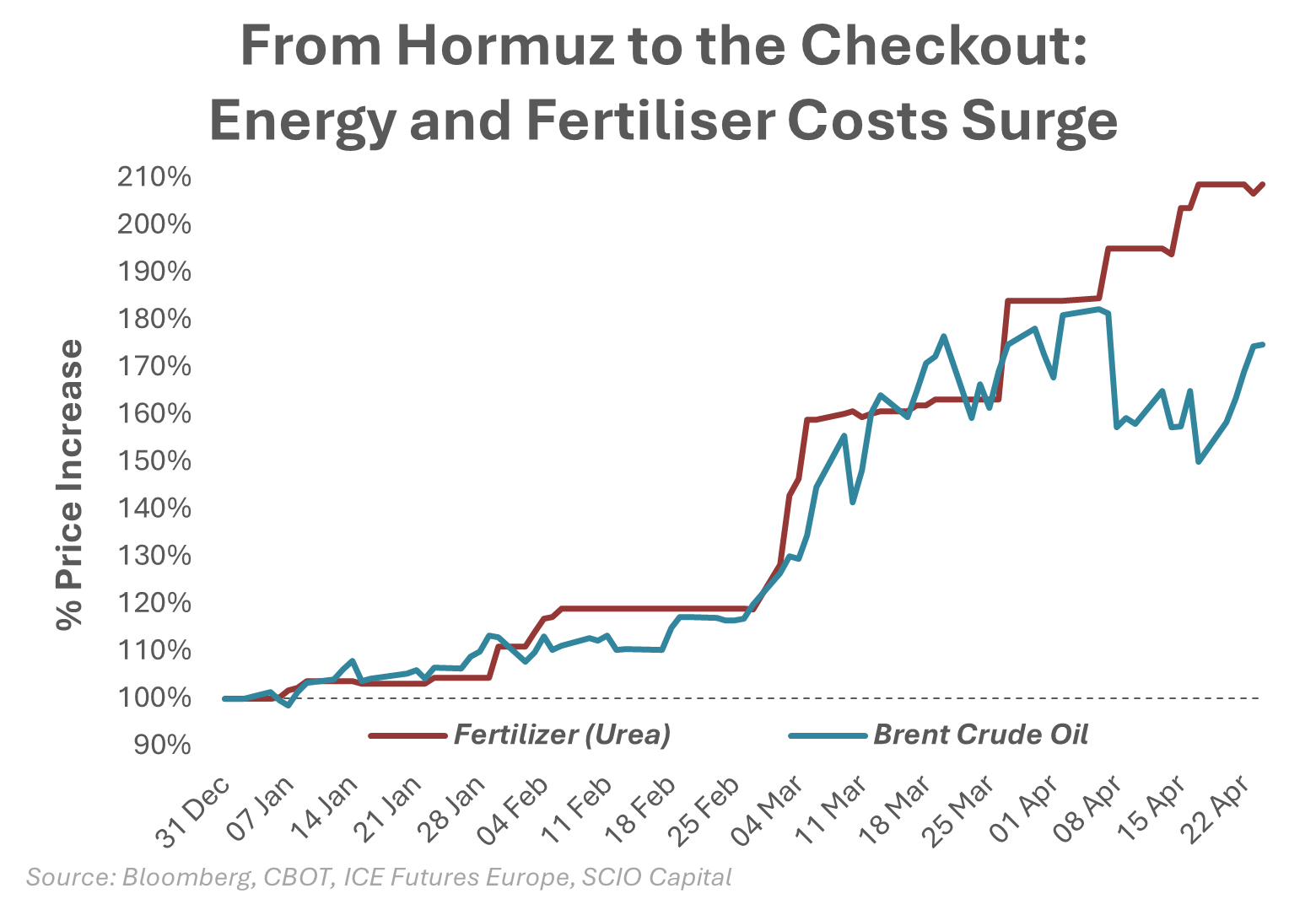
From Hormuz to the Checkout: Energy and Fertiliser Costs Surge

Greg Branch
Partner and CIO

The cost of putting food on the table is soaring.

The Iran war has effectively shut the Strait of Hormuz, one of the world’s most important energy and industrial chokepoints.  

The first-order effects are obvious: higher fuel prices, transport costs and grocery bills. Global food prices rose 2.4% in March, according to the UN’s Food and Agriculture Organization.
But the second-order effects may be even more important.

·        Petrochemical disruption is pushing up the cost of plastics and polymers used in everything from food packaging to auto parts.

·        Fertiliser shortages risk lower crop yields later this year, particularly if farmers respond to higher costs by using less fertiliser or switching crops.

·        Industrial production is slowing. Germany has already cut its 2026 growth forecast in half, from 1.0% to 0.5%.

·        Airlines are cutting routes as jet fuel prices spike. Lufthansa alone has announced 20,000 short-haul flight cancellations through October.

And then there is helium: rarely discussed, but essential. Qatar accounts for roughly one-third of global helium supply, and helium is critical for MRI machines, semiconductor manufacturing, aerospace and other high-tech applications.

This is not simply about filling up your tank or paying more at the supermarket... it’s a reminder that the global economy is built on supply chains which, when broken, have real-world consequences.

And the longer the conflict continues, the more pronounced these consequences are likely to become.

For investors, this type of supply-side shock points to lower growth, higher inflation, and rising corporate default risk.

In this environment, lending disciple, solid collateral, and structural protections really matter.

So be prepared.

As Buffett says, “Only when the tide goes out do you discover who's been swimming naked.”

Greg Branch
Partner and CIO

Are You a Prospective Investor?

 Hero Background Image
Back to TOP
Table of Contents
Updated on
January 19, 2024
2 minute read
Greg Branch
Partner and CIO

The cost of putting food on the table is soaring.

The Iran war has effectively shut the Strait of Hormuz, one of the world’s most important energy and industrial chokepoints.  

The first-order effects are obvious: higher fuel prices, transport costs and grocery bills. Global food prices rose 2.4% in March, according to the UN’s Food and Agriculture Organization.

But the second-order effects may be even more important.

·        Petrochemical disruption is pushing up the cost of plastics and polymers used in everything from food packaging to auto parts.

·        Fertiliser shortages risk lower crop yields later this year, particularly if farmers respond to higher costs by using less fertiliser or switching crops.

·        Industrial production is slowing. Germany has already cut its 2026 growth forecast in half, from 1.0% to 0.5%.

·        Airlines are cutting routes as jet fuel prices spike. Lufthansa alone has announced 20,000 short-haul flight cancellations through October.

And then there is helium: rarely discussed, but essential. Qatar accounts for roughly one-third of global helium supply, and helium is critical for MRI machines, semiconductor manufacturing, aerospace and other high-tech applications.

This is not simply about filling up your tank or paying more at the supermarket... it’s a reminder that the global economy is built on supply chains which, when broken, have real-world consequences.

And the longer the conflict continues, the more pronounced these consequences are likely to become.

For investors, this type of supply-side shock points to lower growth, higher inflation, and rising corporate default risk.

In this environment, lending disciple, solid collateral, and structural protections really matter.

So be prepared.

As Buffett says, “Only when the tide goes out do you discover who's been swimming naked.”

Are You a Prospective Investor?

Let’s Talk More!
arrowarrow
Back to TOP