Table of Contents
4 min read
August 7, 2026

Concerned about a sharp market correction? If so, avoid CoCos like the plague.

Greg Branch
Partner and CIO

Contingent convertible bonds (CoCos), aka Additional Tier 1 bonds (AT1s), were introduced in the aftermath of the global financial crisis to help European banks shore up their balance sheets.

Banks typically market them as higher-yielding bonds, but buyer beware. The fact that regulators allow these instruments to count toward a bank's capital ratios should itself serve as a red flag to investors who consider them merely debt. Make no mistake — this is a form of equity masquerading as debt, and at current levels investors are not, in our opinion, being adequately compensated for the risks.

What risks? They include:

• Loss absorption / write-off risk: If a bank's CET1 ratio falls below a trigger level, the notes absorb losses instantly via write-down or conversion to equity in a poorly capitalised bank. Furthermore, authorities can write AT1 down regardless of where the CET1 ratio sits.

• Discretionary coupons: Banks can cancel interest payments without triggering a default w/cancelled payments never made up.

• Call asymmetry: Coupons are fixed. If rates decline and/or credit spreads tighten, banks can call the bonds at par, forcing investors to reinvest at lower yields. Upside is capped; downside is not.

Proponents of AT1s are quick to point out that CET1 ratios across European banks currently average ~16%, comfortably exceeding the 5.125% or 7% trigger levels (depending on the the instrument), and that many issuers are considered systemically important banks.

Our rebuttal? Consider Credit Suisse: a systemically important bank with a 167-year history, whose CET1 ratio stood at 14.1% at the end of 2022 but whose CHF 16 billion of AT1 bonds were written down to zero less than three months later by regulatory decision.

Furthermore, numerous indicators (compressed spreads, high asset valuations, surging debt supply) suggest we are now in a late-cycle credit environment.

Why does this matter? Because banks are basically highly leveraged blind pool investments. Investing in AT1s can be likened to going to a casino, only worse: you may walk away with nothing but the shirt on your back, but at least the casino gives you free drinks and maybe a voucher for the buffet.

In a sharp downturn, bank capital ratios are hit from both directions: on the capital side (losses, lower earnings) and on the risk-weighted asset side (higher volatility feeds risk metrics, credit downgrades push up risk weightings).

And while AT1 issuers are stronger than the average high yield borrower, a high yield bond has a maturity date, a contractual coupon, and enforceable creditor rights. An AT1 has none of the three: no maturity, a cancellable coupon, and a principal balance a regulator can extinguish on a Sunday afternoon.
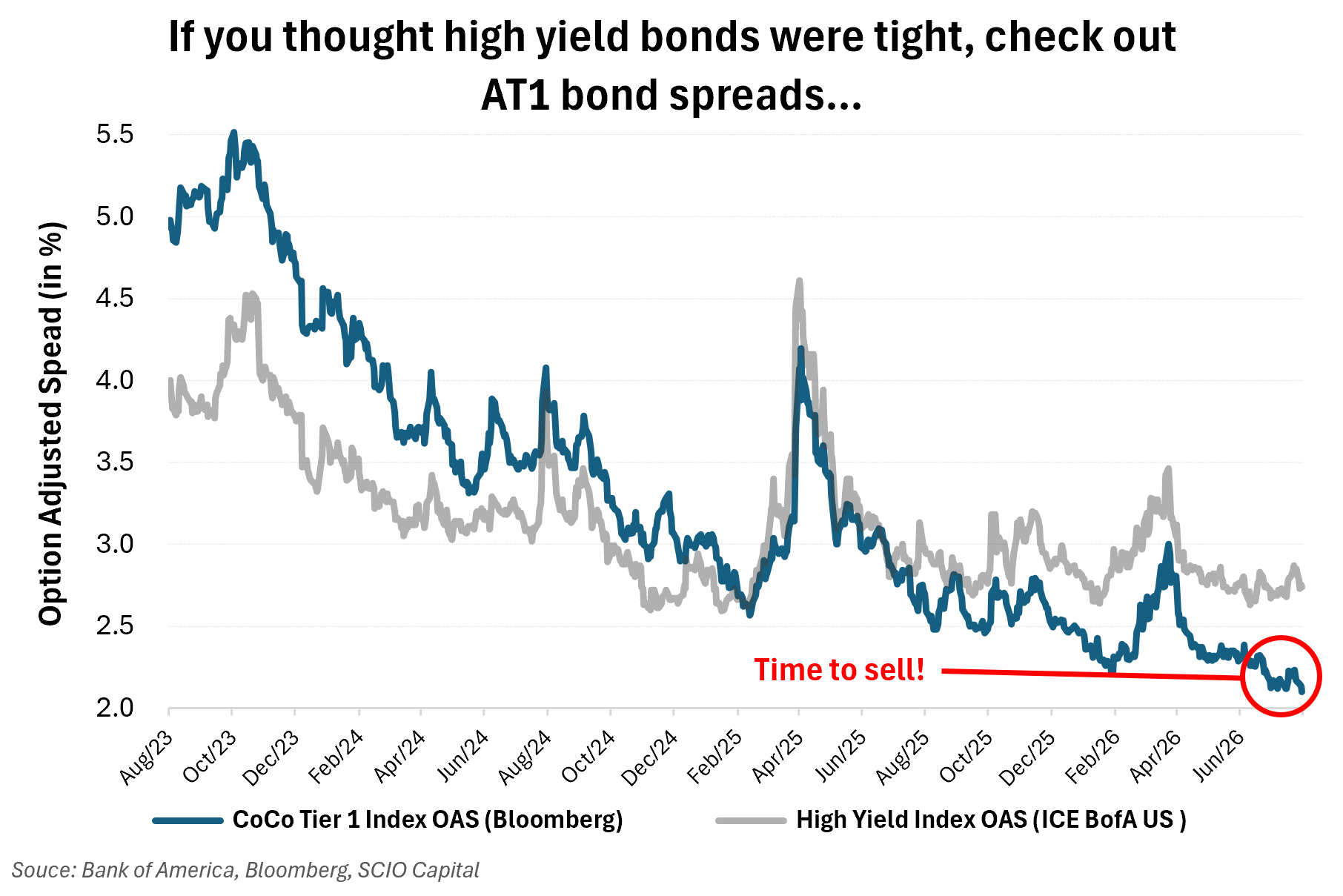
Three years ago, AT1 bonds paid you roughly 90bp more than US high yield. Today they pay you around 60bp less.

Our view: take your money and run.

Greg Branch
Partner and CIO

Are You a Prospective Investor?

 Hero Background Image

Related Articles

Back to TOP
Table of Contents
Updated on
January 19, 2024
2 minute read
Greg Branch
Partner and CIO

Contingent convertible bonds (CoCos), aka Additional Tier 1 bonds (AT1s), were introduced in the aftermath of the global financial crisis to help European banks shore up their balance sheets.

Banks typically market them as higher-yielding bonds, but buyer beware. The fact that regulators allow these instruments to count toward a bank's capital ratios should itself serve as a red flag to investors who consider them merely debt. Make no mistake — this is a form of equity masquerading as debt, and at current levels investors are not, in our opinion, being adequately compensated for the risks.

What risks? They include:

• Loss absorption / write-off risk: If a bank's CET1 ratio falls below a trigger level, the notes absorb losses instantly via write-down or conversion to equity in a poorly capitalised bank. Furthermore, authorities can write AT1 down regardless of where the CET1 ratio sits.

• Discretionary coupons: Banks can cancel interest payments without triggering a default w/cancelled payments never made up.

• Call asymmetry: Coupons are fixed. If rates decline and/or credit spreads tighten, banks can call the bonds at par, forcing investors to reinvest at lower yields. Upside is capped; downside is not.

Proponents of AT1s are quick to point out that CET1 ratios across European banks currently average ~16%, comfortably exceeding the 5.125% or 7% trigger levels (depending on the the instrument), and that many issuers are considered systemically important banks.

Our rebuttal? Consider Credit Suisse: a systemically important bank with a 167-year history, whose CET1 ratio stood at 14.1% at the end of 2022 but whose CHF 16 billion of AT1 bonds were written down to zero less than three months later by regulatory decision.

Furthermore, numerous indicators (compressed spreads, high asset valuations, surging debt supply) suggest we are now in a late-cycle credit environment.

Why does this matter? Because banks are basically highly leveraged blind pool investments. Investing in AT1s can be likened to going to a casino, only worse: you may walk away with nothing but the shirt on your back, but at least the casino gives you free drinks and maybe a voucher for the buffet.

In a sharp downturn, bank capital ratios are hit from both directions: on the capital side (losses, lower earnings) and on the risk-weighted asset side (higher volatility feeds risk metrics, credit downgrades push up risk weightings).

And while AT1 issuers are stronger than the average high yield borrower, a high yield bond has a maturity date, a contractual coupon, and enforceable creditor rights. An AT1 has none of the three: no maturity, a cancellable coupon, and a principal balance a regulator can extinguish on a Sunday afternoon.

Three years ago, AT1 bonds paid you roughly 90bp more than US high yield. Today they pay you around 60bp less.

Our view: take your money and run.

Are You a Prospective Investor?

Let’s Talk More!
arrowarrow
Back to TOP