
.svg)

How Britain Priced Its Factories Out of Business


Britain’s electricity prices are some of the highest in the developed world, and it is paying that price to address less than 1% of the global CO2 emissions. That is the uncomfortable truth at the heart of UK energy policy and it points squarely toward the technology the political consensus has been slow to embrace at scale: nuclear power, and small modular reactors in particular.
The cost of conscience
The numbers are stark. Deloitte found the UK had the highest industrial electricity prices of all 24 IEA member countries in 2023, with British firms paying roughly 50% more than German and French rivals and around four times what US companies pay. Make UK reached the same verdict in June 2025: UK industrial power costs four times higher than the US and 46% above the global average.
The consequence? The combined output of Britain's energy-intensive industries — steel, chemicals, cement, glass, ceramics, paper — has fallen by a third since 2021, to its lowest level since records began in 1990. The CBI reports that 40% of UK firms are holding back investment because of energy costs.
Limited impact
And what is all this buying, climatically? The UK accounted for 0.81% of global CO₂ emissions in 2024 — under 1% and falling. China alone produced 31.8%, the United States 12.7%, and India 8.3%.
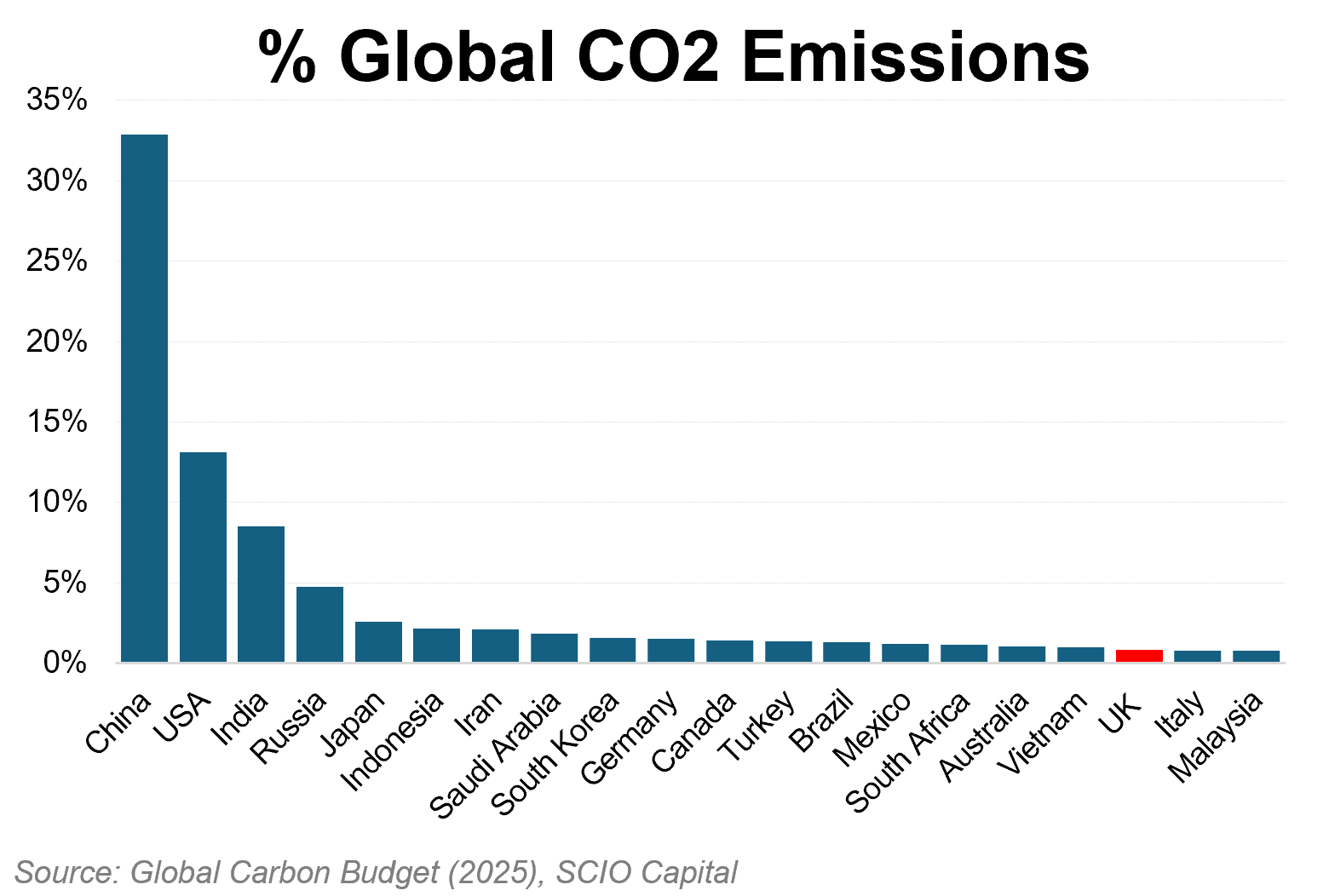
When a British plant closes and production moves to a country with a dirtier grid, global emissions can actually rise. Britain exports the carbon, the jobs, and the tax base together — and calls it progress.
The reliability problem
The uncomfortable truth headlines tend to avoid is that the dominant driver of Britain's high electricity prices is gas, not green levies. Under Britain's marginal-pricing system, the most expensive unit needed to meet demand sets the price for all electricity. Because the UK leans heavily on gas — 30% of generation in 2024, against 16% in Germany and just 3% in France — gas sets the wholesale price most of the time.
That exposure is itself a consequence of retiring firm, dispatchable capacity faster than reliable low-carbon replacements were built. Renewables are intermittent; without large-scale storage they require gas backup, which keeps gas-set pricing at the centre of the system.
The answer to a gas-dependency problem is more firm, low-carbon baseload. And that is precisely what nuclear provides and intermittent renewables do not.
The nuclear opportunity
Britain has, encouragingly, already taken the first step. Rolls-Royce SMR was selected as preferred bidder in the Great British Energy – Nuclear competition in June 2025, with Wylfa confirmed as the first UK site that November and up to three units planned for the initial project.
The appeal of small modular reactors is straightforward. Each Rolls-Royce unit is designed to generate around 470 MWe — enough to power between 500 thousand and a million homes — from a compact, factory-built design intended to sidestep the cost overruns and decade-long timelines that plagued mega-projects like Hinkley Point C. Crucially, SMRs deliver what renewables structurally cannot: firm, weather-independent, genuinely low-carbon baseload, available around the clock regardless of wind or sunshine.
The combination of low-carbon and dispatchable is the missing piece in Britain's grid. It addresses both the emissions concern and the reliability concern, and over the long run loosens the grip that volatile international gas prices hold over what British households and factories pay.
The policy question is not whether to pursue SMRs, but why not faster, and at far greater scale than three units on one site.
The bottom line
Britain is bearing sky-high power costs to chase a sub-1% slice of global emissions, hollowing out its industrial base in the process. A serious energy policy would prize affordability, reliability, and industrial competitiveness alongside emissions.
And on every one of those metrics, an accelerated, scaled-up commitment to nuclear, with small modular reactors at its core, isn't a fringe position. It's common sense.

.png)


.svg)


