Table of Contents
4 min read
August 5, 2026

Will the U.S. Strategic Petroleum Reserve be depleted by next Easter?

Greg Branch
Partner and CIO

While America is burning through its insurance policy to hold down the price of oil, credit markets are asleep at the wheel.

The Strategic Petroleum Reserve (SPR) was created to protect the United States against a supply shock. But it was designed to bridge a disruption, not subsidise one indefinitely.

With Iran restricting transit through the Strait of Hormuz and, more recently, Houthi activity repricing the Red Sea route, the U.S. has been drawing heavily on the SPR to help contain oil and petrol prices.

Three numbers to consider:

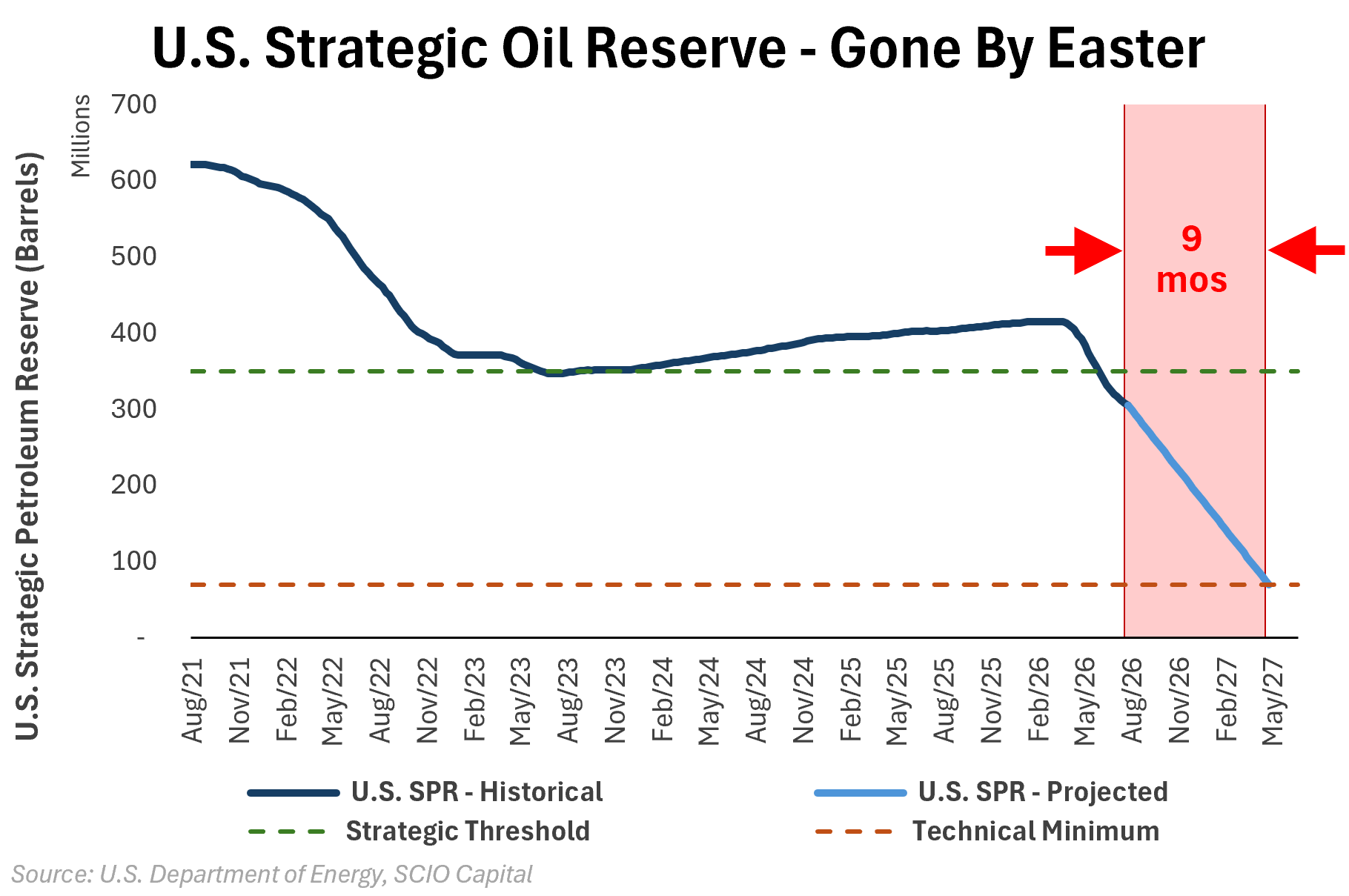
→ The SPR has fallen to approximately 305 million barrels, its lowest level since 1983.

→ Depletion rates have averaged six million barrels a week since the Iranian conflict began. At this rate, the SPR reaches the 252.4-million-barrel statutory threshold in early Q4 2026. Below that level, certain non-emergency drawdown authorities become restricted.

→ At this rate the DOE’s stated operational minimum of approximately 70 million barrels would be reached within nine months. SPR releases are a short-term fix. The longer the conflict with Iran continues, the more exposed the U.S. becomes to the next energy shock.
How we think this plays out in credit:

→ Phase 1: Renewed inflation fears, commodity volatility, weaker equities, wider credit spreads and pressure on the long end.

→ Phase 2: Oil prices eventually fall, even with Hormuz still impaired, because households and businesses can no longer afford to consume at previous levels. Corporate credit losses rise significantly from today’s levels.

How we are positioning:

• More exposure to countercyclical and recession-resilient sectors.

• Less exposure to energy-sensitive cyclicals (airlines, chemicals, freight and transport) and to leveraged issuers with weak pricing power.

• Shorter-duration credit to provide protection against an inflation surprise that the yield curve is not pricing.

• More residential mortgages, prime consumer credit and energy infrastructure: collateral and contracted cash flows that should prove resilient if the economy slows.

Reserves create optionality. The U.S. is exercising that option to smooth today’s oil price. Rebuilding it may become easier only after demand has weakened—and something has broken.

In credit, you do not get paid for being early. You get paid for still being solvent.

Greg Branch
Partner and CIO

Are You a Prospective Investor?

 Hero Background Image
Back to TOP
Table of Contents
Updated on
January 19, 2024
2 minute read
Greg Branch
Partner and CIO

While America is burning through its insurance policy to hold down the price of oil, credit markets are asleep at the wheel.

The Strategic Petroleum Reserve (SPR) was created to protect the United States against a supply shock. But it was designed to bridge a disruption, not subsidise one indefinitely.

With Iran restricting transit through the Strait of Hormuz and, more recently, Houthi activity repricing the Red Sea route, the U.S. has been drawing heavily on the SPR to help contain oil and petrol prices.

Three numbers to consider:

→ The SPR has fallen to approximately 305 million barrels, its lowest level since 1983.

→ Depletion rates have averaged six million barrels a week since the Iranian conflict began. At this rate, the SPR reaches the 252.4-million-barrel statutory threshold in early Q4 2026. Below that level, certain non-emergency drawdown authorities become restricted.

→ At this rate the DOE’s stated operational minimum of approximately 70 million barrels would be reached within nine months. SPR releases are a short-term fix. The longer the conflict with Iran continues, the more exposed the U.S. becomes to the next energy shock.

How we think this plays out in credit:

→ Phase 1: Renewed inflation fears, commodity volatility, weaker equities, wider credit spreads and pressure on the long end.

→ Phase 2: Oil prices eventually fall, even with Hormuz still impaired, because households and businesses can no longer afford to consume at previous levels. Corporate credit losses rise significantly from today’s levels.

How we are positioning:

• More exposure to countercyclical and recession-resilient sectors.

• Less exposure to energy-sensitive cyclicals (airlines, chemicals, freight and transport) and to leveraged issuers with weak pricing power.

• Shorter-duration credit to provide protection against an inflation surprise that the yield curve is not pricing.

• More residential mortgages, prime consumer credit and energy infrastructure: collateral and contracted cash flows that should prove resilient if the economy slows.

Reserves create optionality. The U.S. is exercising that option to smooth today’s oil price. Rebuilding it may become easier only after demand has weakened—and something has broken.

In credit, you do not get paid for being early. You get paid for still being solvent.

Are You a Prospective Investor?

Let’s Talk More!
arrowarrow
Back to TOP